Solar Battery Storage: Which Battery Size Suits Your Home?
The right solar battery size matches your evening electricity use, not your panel size. This guide compares four battery capacities from 5kWh to 15kWh+ on five criteria: usable capacity, evening coverage, power output, typical installed price and the share of solar generation you keep. Solar batteries carry 0% VAT until 31 March 2027, whether fitted with new panels or added to an existing system.
Interactive Battery Sizing Calculator
Adjust your annual household electricity consumption and solar array size to discover your recommended battery capacity, self-consumption boost, estimated annual bill savings, and daily solar generation surplus.
Easily absorbs daily solar surplus and covers dinner-to-bedtime usage for a typical 3-bedroom household.
Figures are typical estimates, not a quote.
Get quotes for a 10kWh batteryMatches local MCS-certified installers near you.
Four Solar Battery Sizes Compared
Solar battery capacity is measured in usable kWh, the energy you can draw before the battery stops discharging. A UK household using 2,700 kWh a year uses roughly 4 to 5 kWh between 4pm and midnight.
Small battery (5kWh)
Covers the evening peak in a 1–2 bedroom home.
- Usable capacity
- 5kWh
- Covers evening use for
- Low-use homes, about 2,000 kWh a year
- Typical installed price
- £3,000–£4,000
- Self-consumption with 4kWp solar
- 55–65%
Mid-size battery (10kWh)
Covers evening and overnight use for a typical 3-bedroom home.
- Usable capacity
- 9.5–10kWh
- Covers evening use for
- Average homes, 2,700–3,500 kWh a year
- Typical installed price
- £4,500–£6,000
- Self-consumption with 4kWp solar
- 65–75%
Large battery (13.5kWh)
Suits homes with an electric vehicle or heat pump.
- Usable capacity
- 13.5kWh
- Covers evening use for
- High-use homes, 4,000+ kWh a year
- Typical installed price
- £6,500–£8,500
- Self-consumption with 4kWp solar
- 70–80%
Modular stack (15kWh+)
Battery modules add capacity in 2.5–5kWh steps as needs grow.
- Usable capacity
- 15–30kWh
- Covers evening use for
- Homes planning EV and heat pump upgrades
- Typical installed price
- £7,500+
- Self-consumption with 4kWp solar
- 75–85%
Prices are typical UK installed ranges, not a Solar Panels UK quote.
Solar Battery Comparison Table
The table compares the four battery sizes across every criterion in one view, including the yearly saving each adds to a 4kWp solar panel system.
| Criterion | 5kWh | 10kWh | 13.5kWh | 15kWh+ |
|---|---|---|---|---|
| Usable capacity | 5kWh | 9.5–10kWh | 13.5kWh | 15–30kWh |
| Continuous power output | 2.5–3.6kW | 3.6–5kW | 5–11kW | 5–10kW |
| Typical installed price | £3,000–£4,000 | £4,500–£6,000 | £6,500–£8,500 | £7,500+ |
| Self-consumption | 55–65% | 65–75% | 70–80% | 75–85% |
| Extra yearly saving vs no battery | £150–£220 | £220–£320 | £260–£380 | £300–£450 |
| Warranty | 10 years typical | 10 years typical | 10 years typical | 10–15 years |
LFP or NMC: Which Battery Chemistry Lasts Longer?
Lithium iron phosphate (LFP) batteries outlast nickel manganese cobalt (NMC) batteries in home storage, rated for 6,000 or more full cycles against roughly 3,000–4,000 for NMC. LFP cells also resist thermal runaway at higher temperatures, which matters for batteries fitted in garages and lofts. NMC packs store more energy per kilogram, an advantage in cars but rarely in a house.
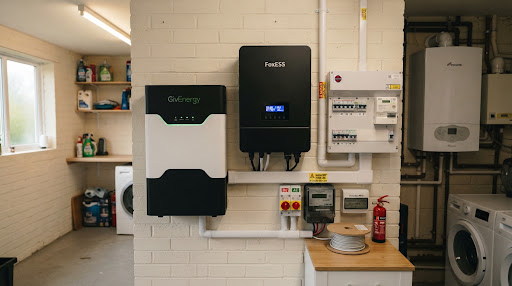
AC-Coupled or DC-Coupled Battery?
A DC-coupled battery connects through a hybrid inverter and suits new solar installations; an AC-coupled battery has its own inverter and suits homes adding storage to existing panels.
| Feature | DC-coupled (hybrid inverter) | AC-coupled |
|---|---|---|
| Best fit | New solar plus battery | Battery added to existing solar |
| Round-trip efficiency | 90–95% | 85–90% |
| Existing inverter | Replaced by hybrid | Kept |
| Charge from cheap overnight tariff | Yes | Yes |
Which Solar Battery Should You Choose?
Choose the battery size that covers your usage between 4pm and midnight, then add capacity only if you run an electric vehicle, a heat pump or an overnight time-of-use tariff.
Existing solar, average home
a 10kWh AC-coupled LFP battery.
New solar, average home
a 4kWp system with a hybrid inverter and 10kWh DC-coupled battery.
Electric vehicle or heat pump
a 13.5kWh battery or modular stack on an overnight tariff.
Call 0151 480 1428 or use the quote form. Homes outside the Solar Panels UK installation area receive up to three quotes from local MCS-certified installers.